
Virginia Criminal Records
Virginia criminal records are held by the State Police, circuit courts, general district courts, and local agencies across the Commonwealth. The Central Criminal Records Exchange serves as the main statewide repository for criminal history data. You can search for Virginia criminal records online through the Virginia Judicial System case portal or request a formal criminal history report directly from the State Police using the SP-167 form. This guide covers where Virginia criminal records are kept, how to find them, and what you can expect from each source.
Virginia Criminal Records at a Glance
The Central Criminal Records Exchange
Virginia Code establishes the Central Criminal Records Exchange (CCRE) as a separate division within the Department of State Police. The CCRE is the sole criminal recordkeeping agency of the Commonwealth, with limited exceptions. It collects and stores arrest records, court dispositions, conviction data, and sentencing information from law enforcement agencies and courts across the entire state. Every adult arrest in Virginia gets reported here.
The State Police Bureau of Criminal Investigation manages the CCRE and handles all formal criminal history record requests from the public. The database is updated continuously. Local agencies report arrests. Courts report dispositions as cases move through the system. This creates a complete criminal history record from the point of first contact to the final case outcome. You can find full details about the CCRE and how it works at the Virginia State Police Criminal History Records page.
The Virginia State Police also operates the Virginia Criminal Information Network (VCIN), which provides computerized criminal justice data to law enforcement agencies statewide. The VCIN feeds from the same CCRE data that powers the public criminal history search.
The Virginia State Police Criminal History Records portal is your starting point for formal criminal history checks, background requests, and sex offender registry searches under Virginia Code § 19.2-387.

The State Police process all formal criminal history record requests through the Central Criminal Records Exchange database, which covers every adult arrest in the Commonwealth.
Search Virginia Criminal Records Online
The Virginia Judicial System provides free online access to criminal case information at vacourts.gov. This portal covers circuit courts in 31 judicial circuits, general district courts in 32 judicial districts, and juvenile and domestic relations district courts in 32 districts. You can search for criminal records by name, case number, or hearing date. Results show case status, party names, hearing dates, and final dispositions.
General district court criminal case records are available online for most participating jurisdictions. These cover misdemeanor offenses, traffic violations, and preliminary hearings for felony charges. Circuit court case records are available in select jurisdictions. For courts not in the online system, an in-person records search at the clerk's office is required. The Virginia Judiciary E-Filing System also gives Virginia State Bar members access to electronic court filings.
The Virginia Judicial System case portal lets anyone search for criminal case status, hearing dates, and dispositions across participating courts statewide without visiting a courthouse in person.
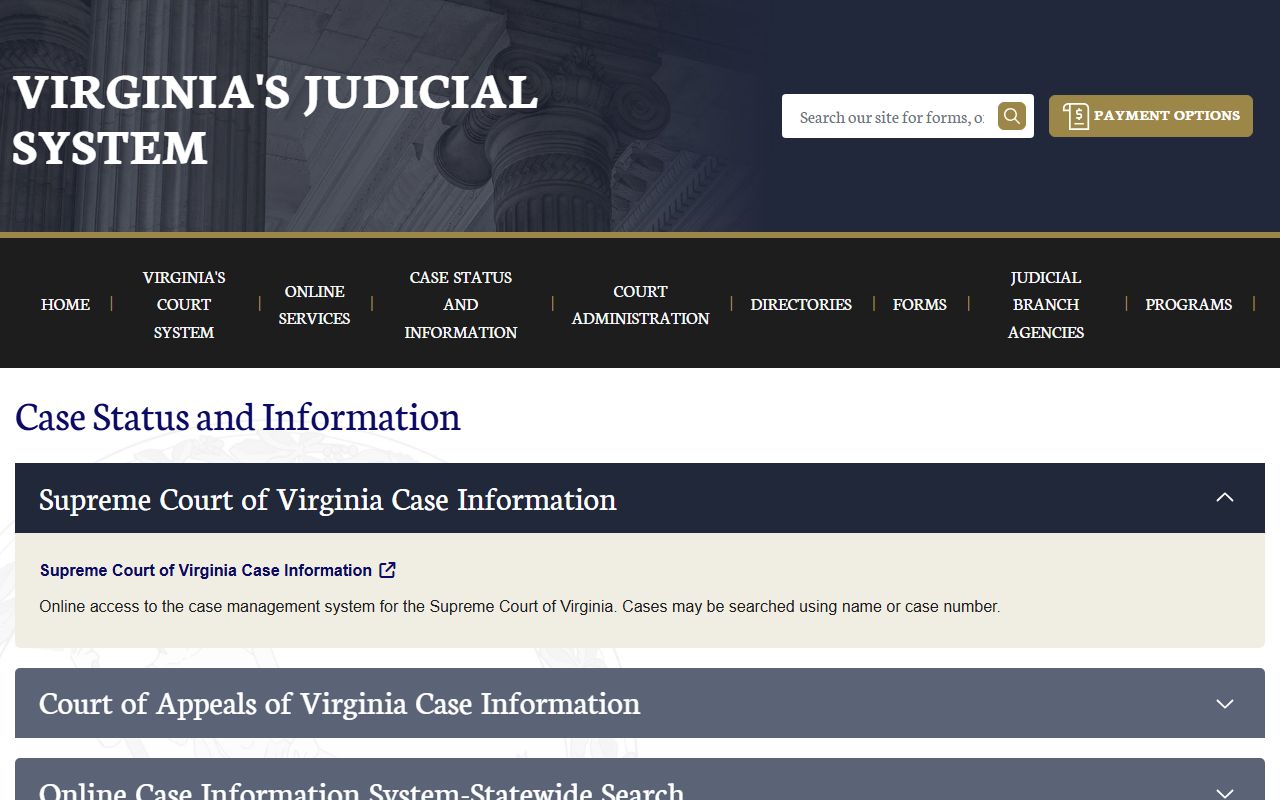
The portal is free to use and includes both criminal and traffic case records, with online payment options available for certain case types in general district courts.
How to Request Virginia Criminal History Records
To get a formal criminal history record from the State Police, you use the SP-167 form. This is the official Criminal History Record Request form used by the Central Criminal Records Exchange. The form requires the subject's full name, date of birth, social security number, and other identifying information. Download it from vsp.virginia.gov/forms.shtm and submit it by mail with your payment.
The State Police offer several types of criminal history searches. A Criminal History Record Name Search costs $15.00 per search of the CCRE database. A Combination Criminal History and Sex Offender Registry search costs $20.00 and checks both databases at once. A Sex Offender Registry search alone using the SP-266 form costs $15.00. Searches for violent sex offenders are free through the public registry online. Non-profit organizations screening volunteers can request a special combination search for $16.00, provided they submit proof of the organization's tax-exempt status along with the SP-167 form.
Under Virginia Code § 19.2-389, criminal history record information is disseminated only to authorized parties. This means not all records are open to any requester. Some data is restricted to criminal justice agencies. Noncriminal justice agencies and individuals may access certain records when specific statutory provisions allow it.
The Virginia State Police forms page has the SP-167 and SP-266 forms available for download, along with instructions for completing and submitting each request type.

Both forms must be completed fully and returned with the correct fee before the State Police can process a criminal history or sex offender registry search.
Note: Criminal history records from the State Police reflect CCRE data as of the search date. Contact the relevant court clerk directly if you need the full case file or certified copies of court documents.
Criminal Records in Virginia Circuit Courts
Virginia's 31 judicial circuits each have a circuit court that handles felony criminal cases, civil matters, family law, and appeals. The circuit court clerk is the official record keeper for each court. Under Virginia Code Title 17.1, circuit court clerks must keep complete and accurate records of all cases filed, including all criminal case files. These records are public unless sealed by court order.
The full criminal case file at a circuit court clerk's office includes the indictment or presentment, pretrial motions, orders, judgments, and sentencing documents. You can visit the clerk's office in person to review and copy these records. Bring the case name or case number if you have it. Copy fees are charged per page under Virginia Code § 17.1-275, with certified copies costing more than plain ones. Some older records may be stored in archives and require advance notice to retrieve.
The Code of Virginia Title 17.1 governing courts of record outlines the record-keeping duties of circuit court clerks for criminal and civil case files across the Commonwealth.
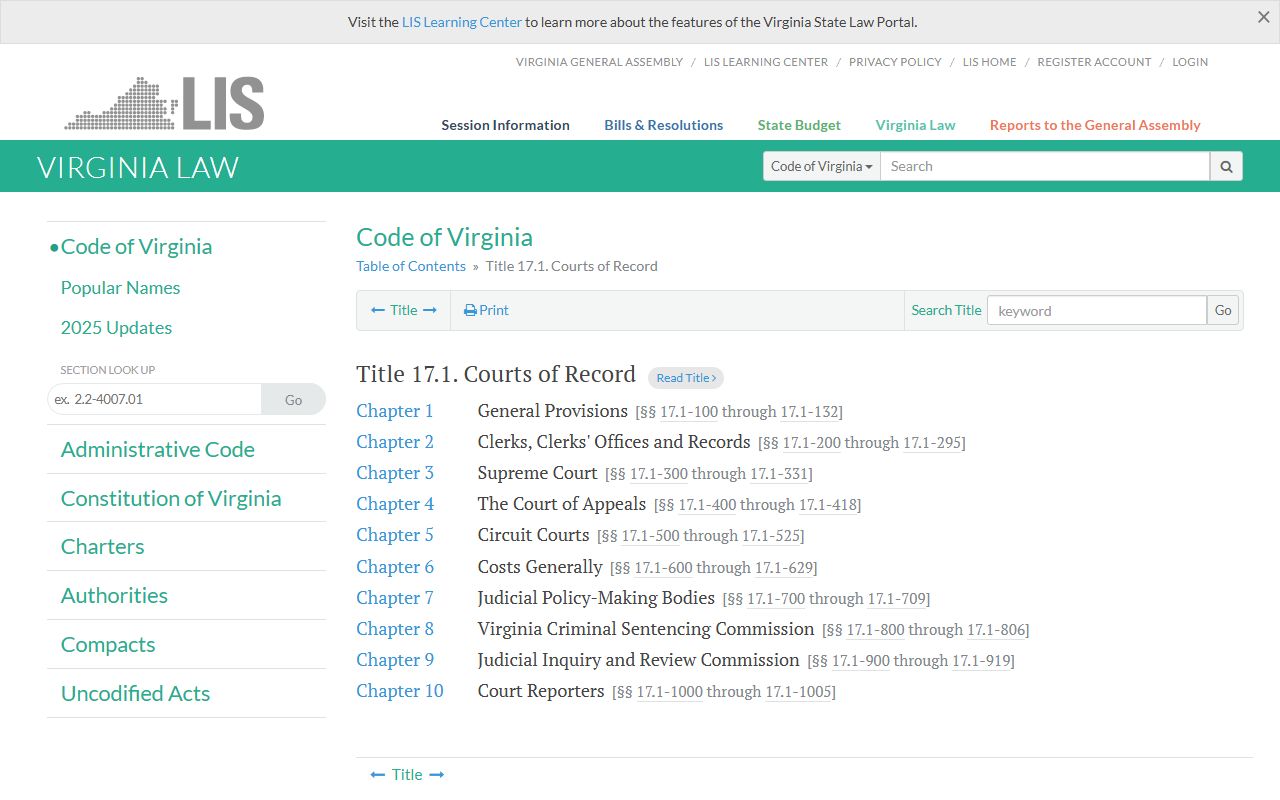
Each circuit court clerk is an elected constitutional officer who serves an eight-year term and is responsible for maintaining the official court record for their jurisdiction.
Misdemeanor Records in General District Courts
Virginia's 32 general district court districts handle misdemeanor criminal cases, traffic violations, and preliminary hearings for felony charges. Misdemeanor criminal records from these courts are public. The general district court clerk maintains case files for all matters heard in that court. Most general district court records are accessible online through the Virginia Judicial System portal. Courts that don't participate in the online system require an in-person visit.
General district courts do not hold jury trials. All criminal matters are heard by a judge. If a defendant wants a jury trial on a misdemeanor charge, they appeal to the circuit court, where the case is heard anew. This means final jury trial records for misdemeanors are held at the circuit court level, not the general district court. For basic case status, hearing dates, and dispositions, the online case portal works well for most jurisdictions.
Online payments are available for certain case types in general district courts. Court hours are typically Monday through Friday, 8:00 AM to 4:30 PM, excluding state holidays.
Virginia Sex Offender and Crimes Against Minors Registry
The Virginia State Police maintain the Sex Offender and Crimes Against Minors Registry under Virginia Code § 9.1-900 through § 9.1-918. The registry holds the names, personal descriptions, conviction information, and photographs of individuals convicted of specified sex offenses in Virginia. Registration is required regardless of when the conviction occurred.
Virginia law creates two classifications: sex offenders and violent sex offenders. Violent sex offenders are searchable for free on the Virginia State Police website through the public registry. To check whether a specific person is listed, you can search the online registry directly or submit an SP-266 form for a formal name search. Under § 9.1-913, the State Police must make registry information available online to the general public. Registration periods vary by offense type under § 9.1-908.
The Virginia Sex Offender and Crimes Against Minors Registry Act sets out the legal framework for registration requirements, verification procedures, and public access to offender information.
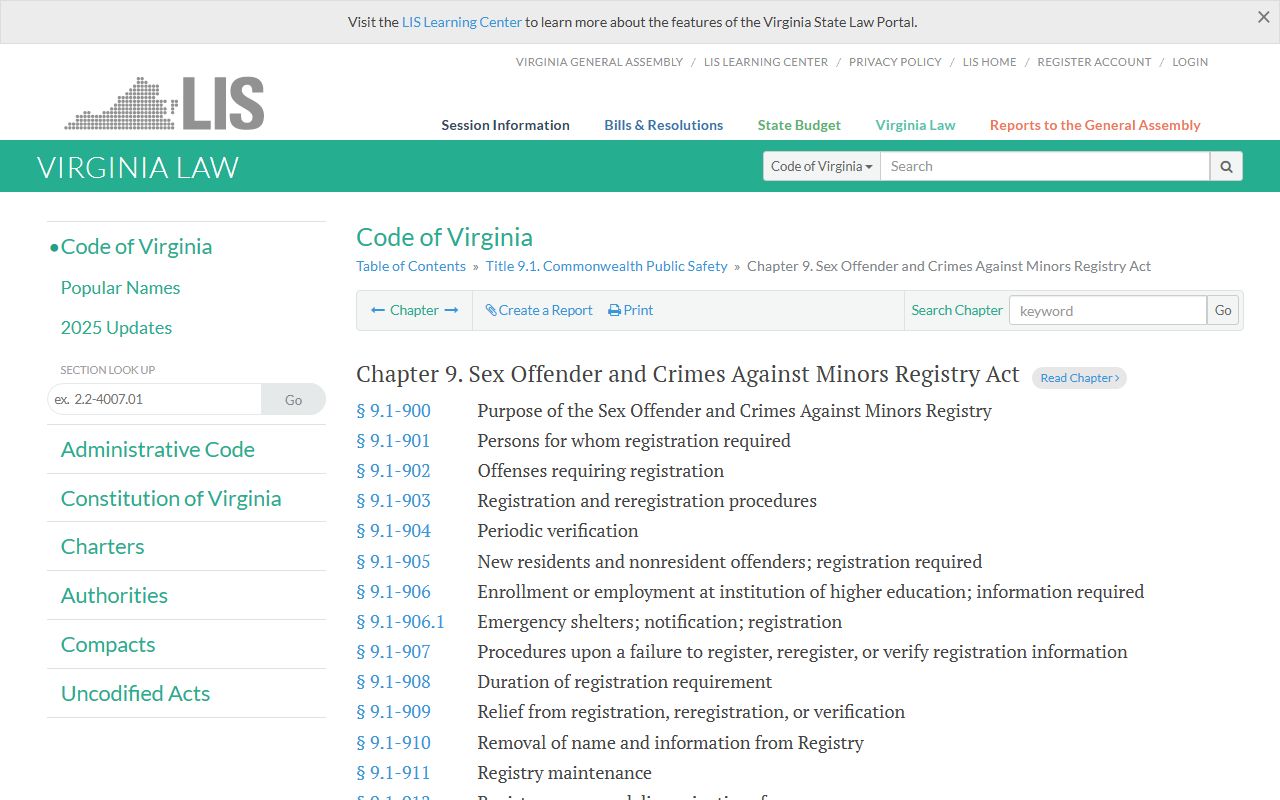
The registry assists law enforcement and the public in identifying individuals convicted of sex offenses and crimes against minors in Virginia, with free public access to violent sex offender information online.
Expungement of Virginia Criminal Records
Virginia law allows certain criminal records to be expunged under Virginia Code § 19.2-392.2. A person charged with a crime who is acquitted, or whose charge is dismissed or results in a nolle prosequi, may file a petition for expungement. This process removes the police and court records related to that specific charge from public access, including electronic records held in the CCRE.
The petition must be filed in the circuit court of the county or city where the case was disposed. It must include the date of arrest, the name of the arresting agency, the specific charge, the date of final disposition, and the petitioner's date of birth. The Commonwealth's Attorney must be served with a copy and has 21 days to file an objection. After a hearing, if the court finds the continued existence of the records causes manifest injustice, it orders expungement. Individuals with no prior criminal history who were arrested on a misdemeanor charge are generally entitled to expungement as long as the Commonwealth does not show good cause to the contrary.
Virginia Code Chapter 23.2 also allows sealing of certain criminal history records under qualifying circumstances. Sealing differs from expungement in that records still exist but are removed from public access.
The Virginia expungement statute under Title 19.2, Chapter 23.1 sets out the full process for petitioning to clear criminal arrest and court records from the Virginia criminal history system.
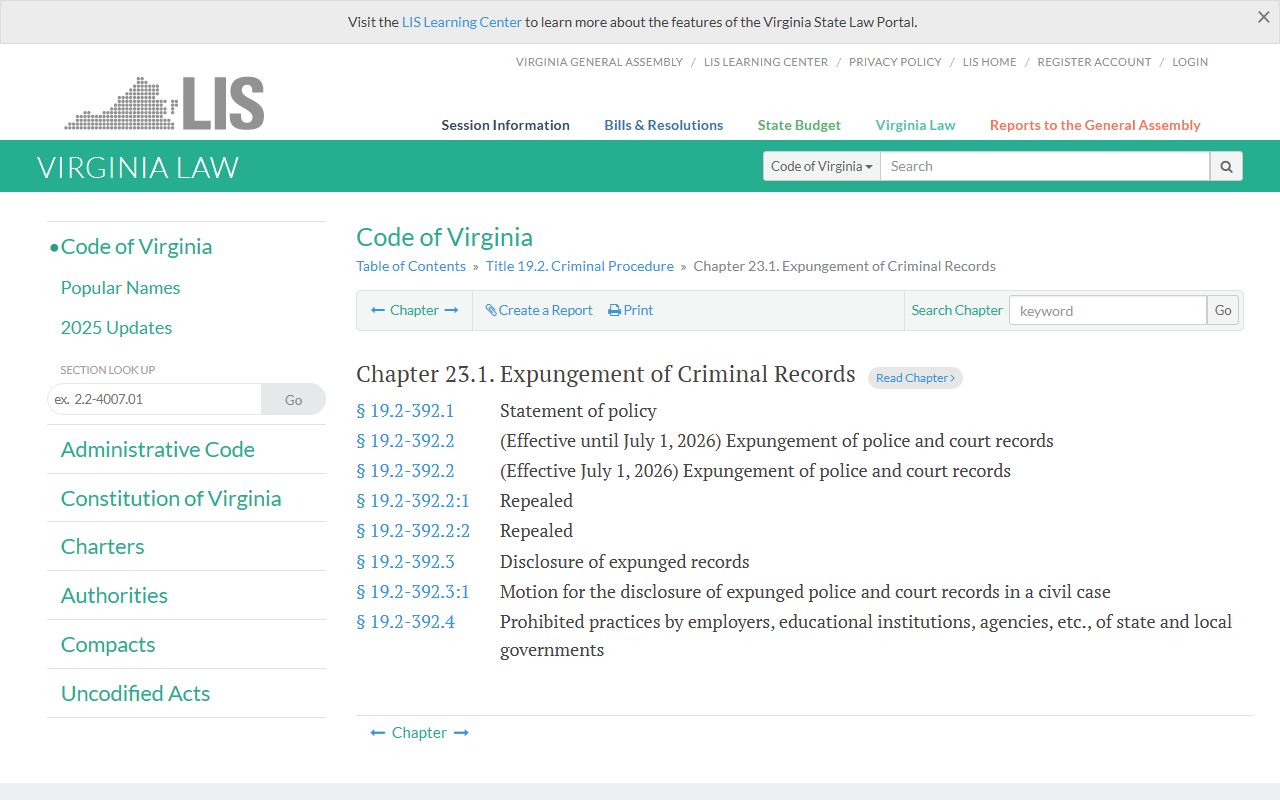
Once granted, an expungement order removes records from both the CCRE database and the local court files, including electronic copies.
Virginia FOIA and Criminal Records Access
The Virginia Freedom of Information Act under Title 2.2, Chapter 37 governs public access to government records, including criminal records held by state and local agencies. Section 2.2-3704 requires public bodies to respond to records requests within five working days. Agencies may charge fees for searching, reviewing, and reproducing records. They must provide advance fee estimates for large requests.
Section 2.2-3706 addresses law enforcement and criminal records specifically. Basic arrest and incident information is generally available under FOIA, including the date, time, and location of incidents, the name of the person arrested, and the charges filed. Detailed investigative files, information about confidential informants, and records related to ongoing investigations may be exempt from public disclosure. Juvenile records have additional restrictions. Section 2.2-3704.01 requires agencies to redact only the exempt portions of a record and provide the rest.
The Virginia Freedom of Information Advisory Council provides guidance on FOIA rights, issues advisory opinions, and offers mediation services for records access disputes. Their website has training materials and a searchable database of prior opinions.
The Virginia FOIA statute sets the rules for public access to government-held criminal records across all state and local agencies in the Commonwealth.
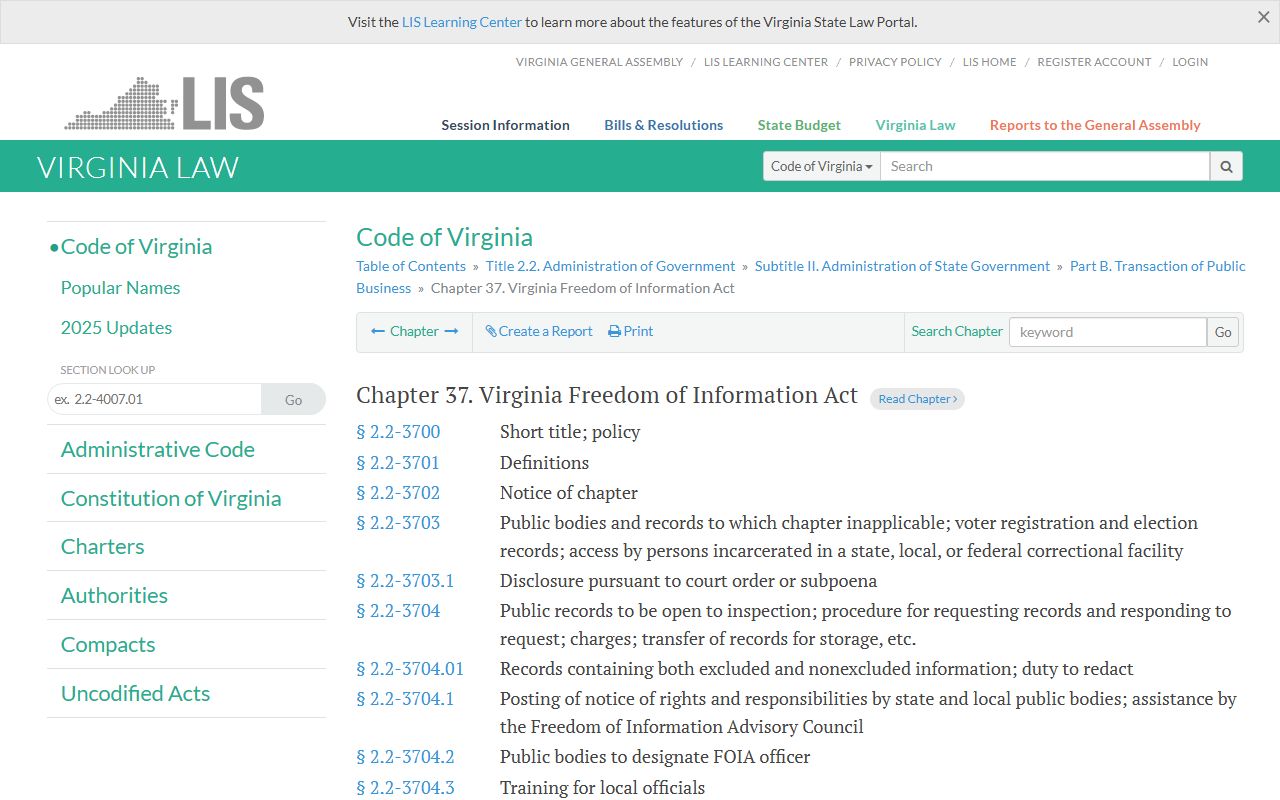
Under FOIA, any person can request public records from a Virginia agency without stating a reason, and the agency must respond within five working days.
Virginia Department of Corrections Records
The Virginia Department of Corrections (VADOC) operates state correctional facilities and maintains inmate records for individuals under state supervision. The Department's website includes an Inmate Locator tool. You can search by name or offender ID to find current custody status and facility assignment. VADOC records are governed by Virginia Code Title 53.1, which establishes the legal framework for state correctional facilities and programs.
The Virginia Parole Board uses CCRE criminal history data when evaluating parole eligibility for qualifying inmates. VADOC also operates Virginia VINE, a free victim notification service. Registered victims receive automatic alerts when an offender's custody status changes, including releases, transfers, and escapes. This service is available at no cost to any person who registers with an offender's VADOC ID.
The Central Criminal Records Exchange statute governs how arrest data, court dispositions, and VADOC commitment records are all linked together in the statewide criminal history system.
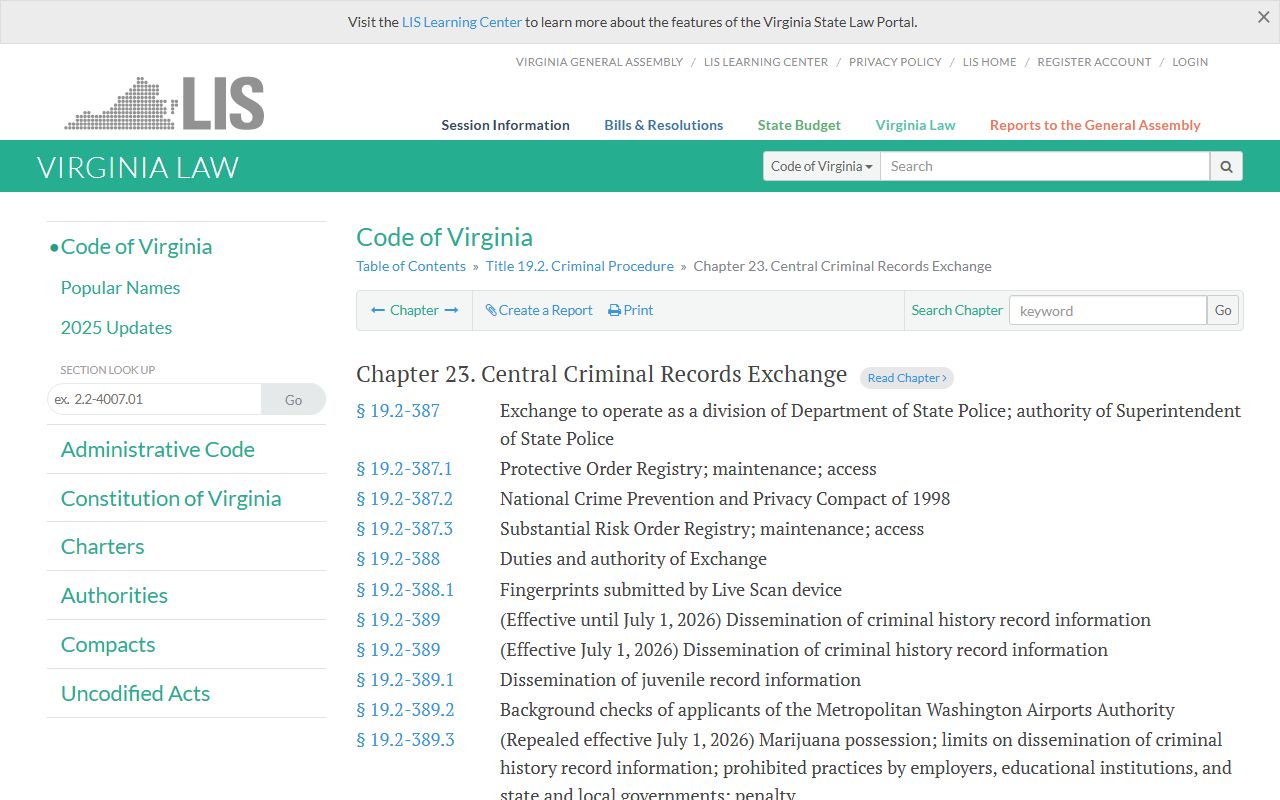
The CCRE functions as the hub connecting arrest records from local law enforcement, disposition data from courts, and commitment records from the Department of Corrections into a single statewide criminal history record.
Virginia Criminal Law and Criminal Records
Virginia Code Title 18.2 contains the Commonwealth's criminal offenses. Chapter 4 covers crimes against persons including homicide, assault, and kidnapping. Chapter 5 addresses crimes against property including larceny, robbery, and burglary. Chapter 6 covers fraud. Each criminal record in Virginia references the specific Title 18.2 code section charged or convicted, which tells you the exact offense and its classification. Felonies are more serious offenses with longer sentences. Misdemeanors carry lesser penalties.
Virginia Code Title 19.2 covers criminal procedure from arrest through sentencing. Chapter 7 governs arrest procedures. Chapter 12 covers preliminary hearings for felony cases. Chapter 15 addresses trial procedures. Chapter 23 establishes the CCRE. Chapter 23.1 provides expungement rights. Chapter 23.2 allows sealing of criminal history records in certain circumstances. Both Title 18.2 and Title 19.2 are cited throughout Virginia criminal records to identify offenses and track the procedural history of each case.
The Virginia criminal code under Title 18.2 defines every criminal offense in the Commonwealth, and each charge listed in a criminal record corresponds to a specific section of this title.
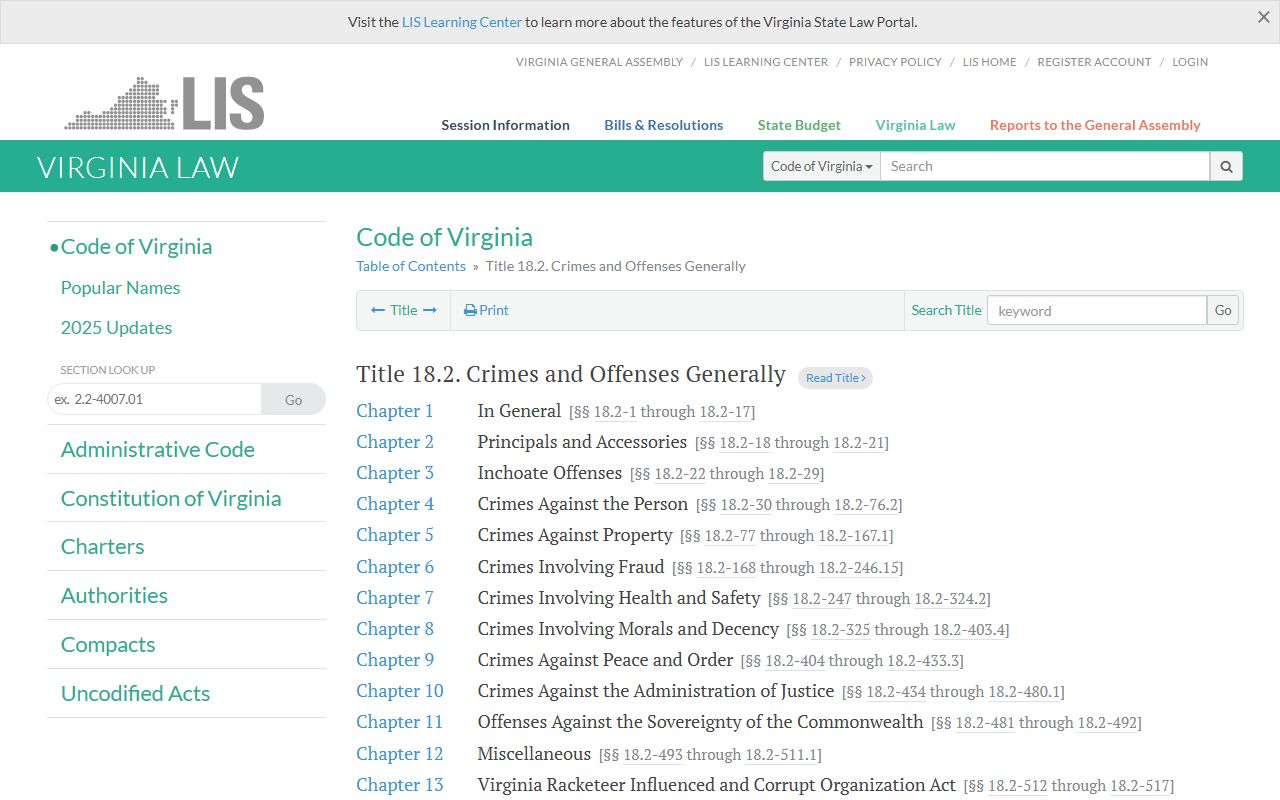
When reviewing a Virginia criminal record, the code section number tells you exactly what offense was charged, whether it was a felony or misdemeanor, and the applicable penalty range under state law.
The Virginia Criminal Procedure Code under Title 19.2 governs every stage of the criminal justice process, from arrest and bail through trial, sentencing, and post-conviction matters.
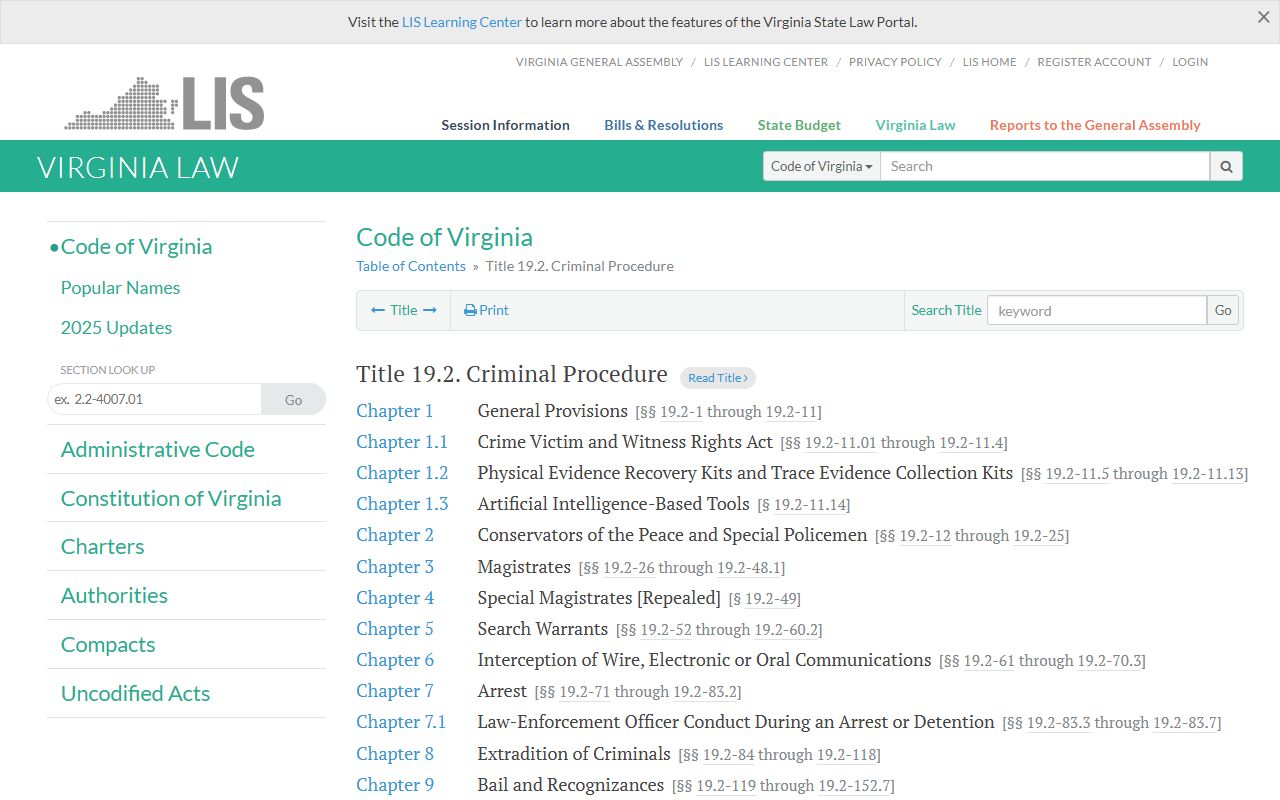
Title 19.2 includes the rules for how arrest records are created, how dispositions are reported, and how individuals can petition to have certain criminal records expunged or sealed.
Virginia Criminal Records Laws and Updates
The Virginia General Assembly's Legislative Information System (LIS) provides access to the current Code of Virginia and tracks pending legislation that may affect criminal records access, expungement procedures, and related matters. The LIS is the official source for confirmed statutory text. When laws change, the LIS updates the Code of Virginia to reflect the new rules.
Recent Virginia legislative sessions have expanded eligibility for expungement and modified the rules for sealing criminal history records. The Division of Legislative Services maintains the Virginia Law Portal at law.lis.virginia.gov, which provides the complete text of Virginia Code including all titles governing criminal law, criminal procedure, and public records access.
The Virginia General Assembly Legislative Information System provides access to current Virginia law and tracks criminal records legislation that affects how records are maintained and accessed.
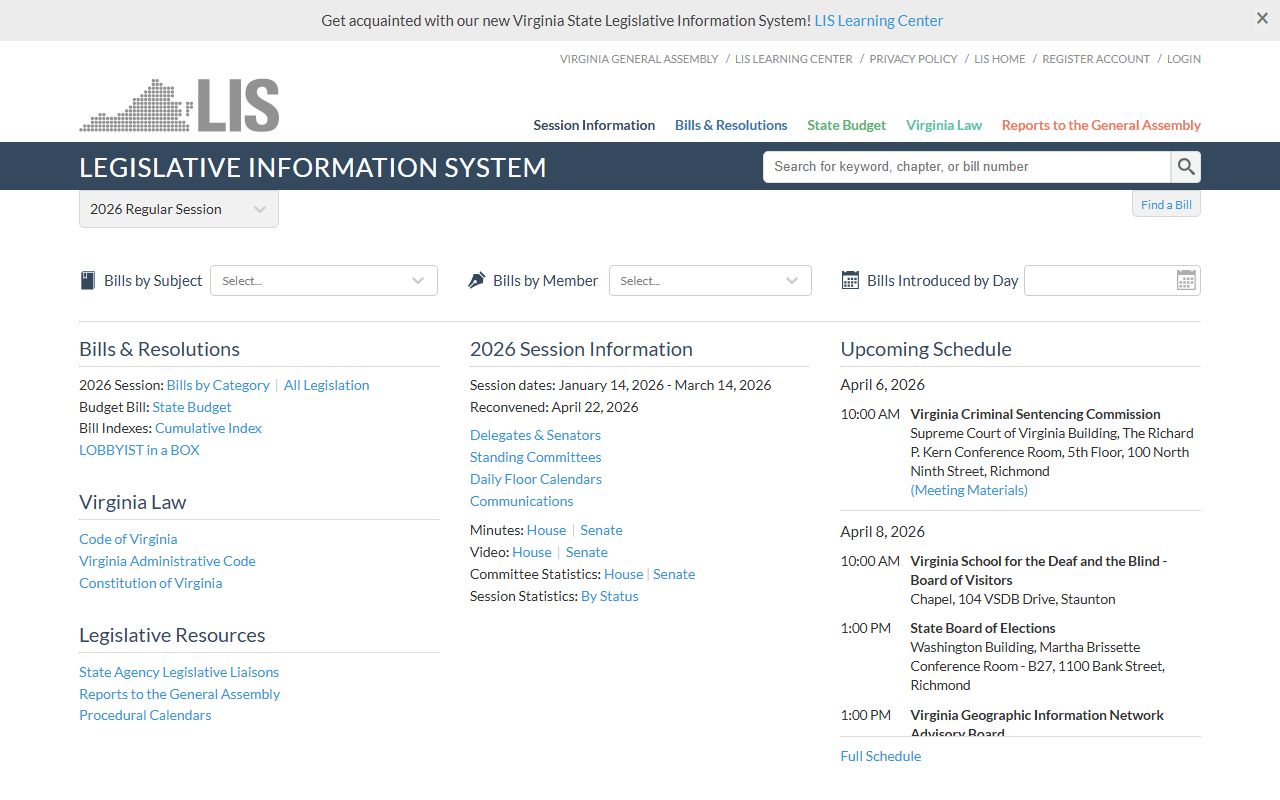
Checking the LIS is useful when you need to confirm the current state of expungement law, FOIA exemptions for criminal records, or any recent statutory changes affecting access to Virginia criminal history information.
The Virginia State Police general website serves as the hub for all State Police criminal justice services, including the CCRE, sex offender registry, and other public safety programs.

The State Police site provides direct access to online forms, fee schedules, and search tools for Virginia criminal records and related criminal justice information.
Browse Virginia Criminal Records by County
Virginia has 95 counties, each with a circuit court and general district court that maintain criminal case records. Select a county below for local court contact information, clerk details, and criminal records resources for that area.
Criminal Records in Virginia Independent Cities
Virginia has 39 independent cities, each with its own circuit court and general district court that handle criminal records separately from the surrounding county. Select a city to find court locations, clerk contacts, and criminal records access for that city.